Research vission for the Jacosson Lab
The Jacobsson Lab is driven by the vision of developing next-generation materials research systems in which artificial intelligence, automated experimentation, and structured data are seamlessly integrated to accelerate scientific discovery. The long-term goal is to move beyond traditional, manual workflows toward data-driven and increasingly autonomous research processes capable of generating, testing, and refining scientific hypotheses with minimal human intervention.
To realise this vision, the group pursues research along four interlinked directions: AI for materials science, automated experimental platforms, FAIR data infrastructure, and the development of perovskite photovoltaics as a model application system.
AI-for Material Science
Artificial intelligence is rapidly transforming the way scientific research is conducted, offering new opportunities to accelerate and augment materials discovery. A central focus of the group is to develop and apply AI methods that enable more efficient, systematic, and increasingly autonomous approaches to materials science.
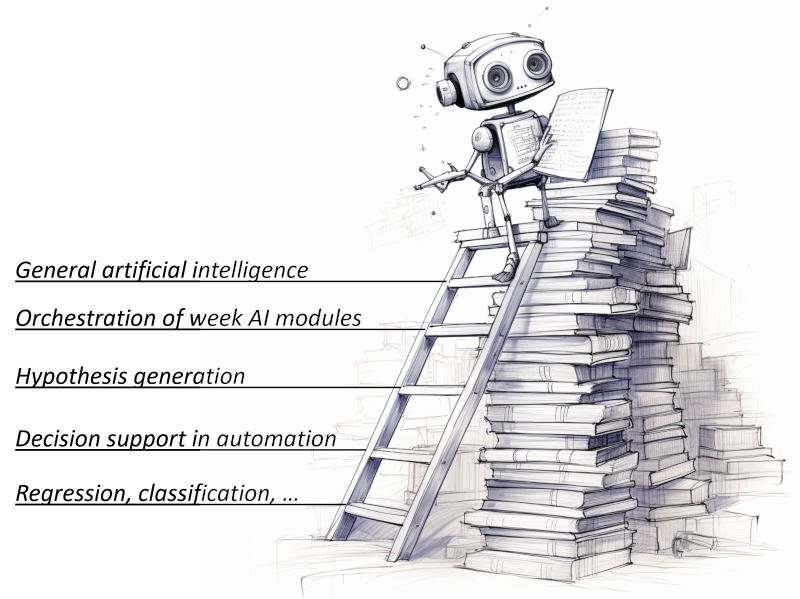
The research spans several complementary directions. One key area is the use of generative AI, including large language models, for scientific knowledge extraction and hypothesis generation. This includes developing methods to identify promising research directions from the scientific literature and to support the early stages of the research cycle.
Another of our research topics is generative models for inverse materials design, aiming to predict material compositions and structures with desired properties. These approaches are complemented by efforts to integrate domain knowledge and physical constraints, ensuring that AI-generated outputs remain scientifically meaningful and experimentally relevant.
A long-term vision is the development of agentic AI systems that integrate these components into coherent, autonomous workflows. Such systems aim to connect knowledge extraction, hypothesis generation, experimental planning, and data analysis into a unified research loop. A key challenge is to ensure that these systems are scientifically grounded, interpretable, and capable of generating experimentally verifiable results.
The overarching goal is to establish a new paradigm for materials research in which AI systems not only accelerate discovery, but actively participate in the generation and validation of scientific knowledge.
Research Automation
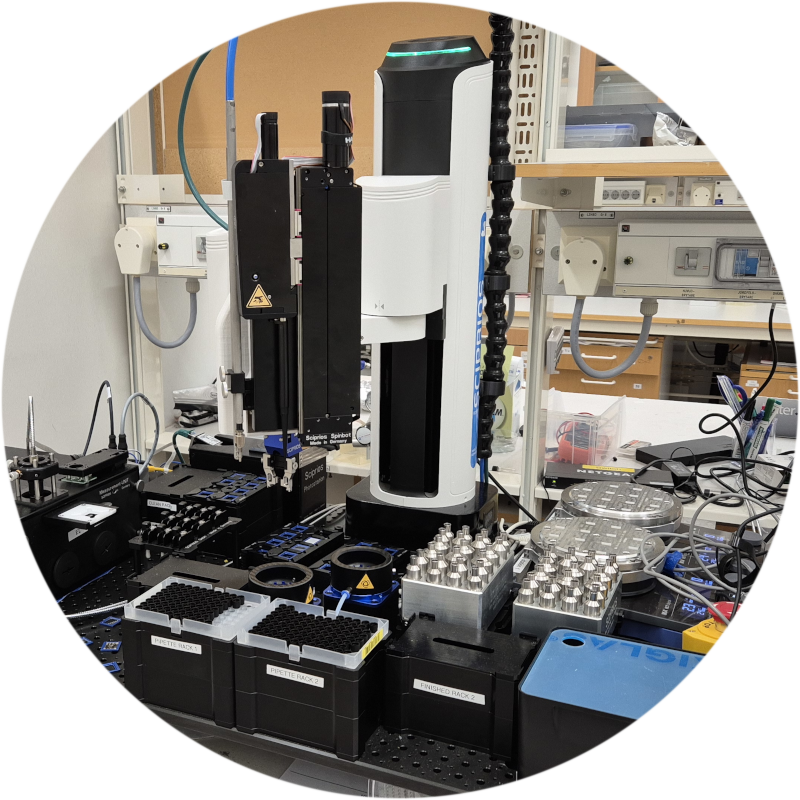
A core infrastructure of the group is a robotic system for automated thin-film synthesis and characterisation that operates in an inert-atmosphere glovebox. The platform enables controlled deposition and analysis of optoelectronic materials and is primarily used for perovskite thin films for solar cell applications.
By automating key experimental steps, such as solution preparation, deposition, and optoelectronic characterisation, the system enables rapid and systematic exploration of complex parameter spaces that are difficult to access through manual experimentation. This leads to improved reproducibility, and the generation of larger structured, high-quality datasets.
The platform is designed to operate in a closed-loop framework, where experimental conditions are iteratively selected based on previous results. This is achieved through active learning strategies, such as Bayesian optimisation, which enable efficient navigation of high-dimensional parameter spaces and prioritisation of informative experiments. With automation we can increase the number of experiments we can do, and with active learning, we can minimise the number of experiments we need to do to reach a given goal. That is a powerful combination.
Beyond increasing experimental throughput, automation also shifts the role of the researcher from manual execution to experimental design and analysis, forming a key component in the development of self-driving laboratories.
The Quest for FAIR Research Data
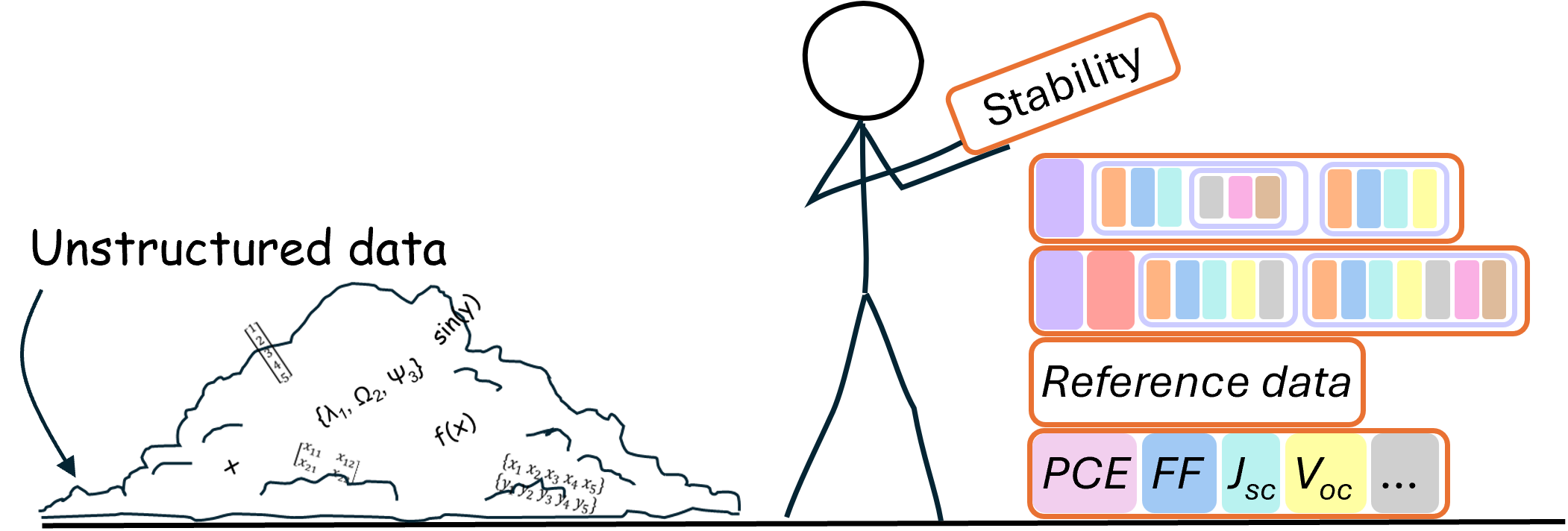
Materials science data is often reported in unstructured and heterogeneous formats, making it difficult to compare results, reproduce experiments, and effectively reuse data across studies. This fragmented data landscape represents a major bottleneck for both human-driven and AI-driven research.
A central focus of the group is the development of standards, tools, and workflows for FAIR research data, i.e., data that is Findable, Accessible, Interoperable, and Reusable. This includes efforts to formalise how perovskite device data are described, with an emphasis on structured, machine-readable representations that support both analysis and automation.
A key effort in this direction is the Perovskite Database Project, where the group has contributed to the development of data schemas, curation workflows, and databases aimed at improving the consistency and usability of perovskite data.
Such structured data representations are essential for enabling reproducible research and form a critical foundation for machine learning, automated experimentation, and autonomous discovery systems.
Perovskite Photovoltaics
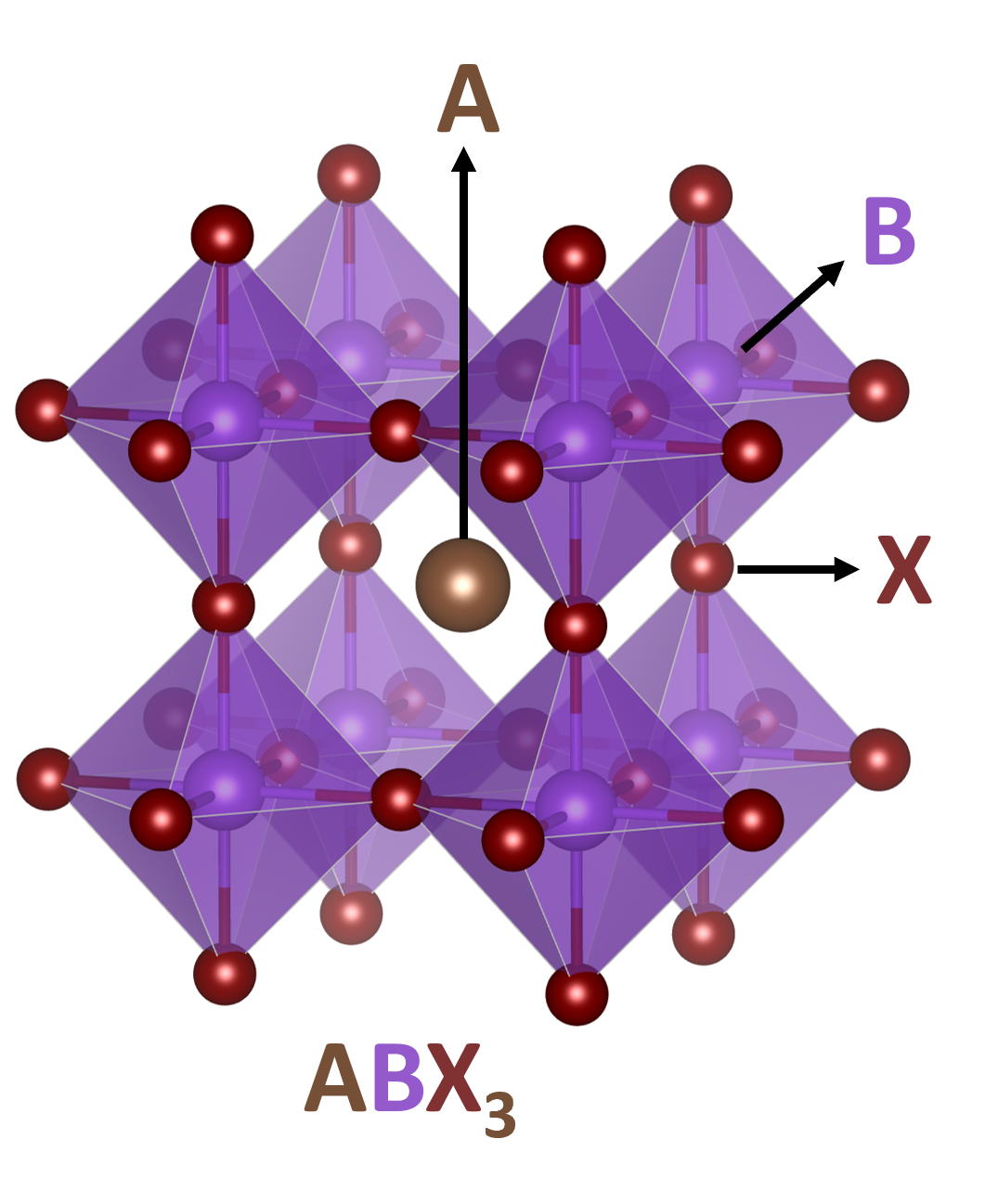
Perovskite photovoltaics constitute the primary experimental application domain of the group and represent the area in which most previous work has been conducted. Beyond their technological value, hybrid perovskites offer a combination of tunable properties, solution-processability, and high device performance that makes them a highly interesting platform for fundamental studies in terms of both material science and research automation.
Recent work has focused on improving the reproducibility and accessibility of perovskite research through the development of FAIR data standards, as well as on additive engineering and surface passivation strategies. In parallel, perovskite systems serve as a testbed for exploring new approaches to hypothesis generation and data-driven materials design.
Looking forward, perovskite photovoltaics play a central role in the integration of AI and automated experimentation within the group. The combination of rich parameter spaces, well-defined performance metrics, and compatibility with high-throughput processing makes these systems particularly well suited for exploring closed-loop optimisation and the development of autonomous discovery workflows.